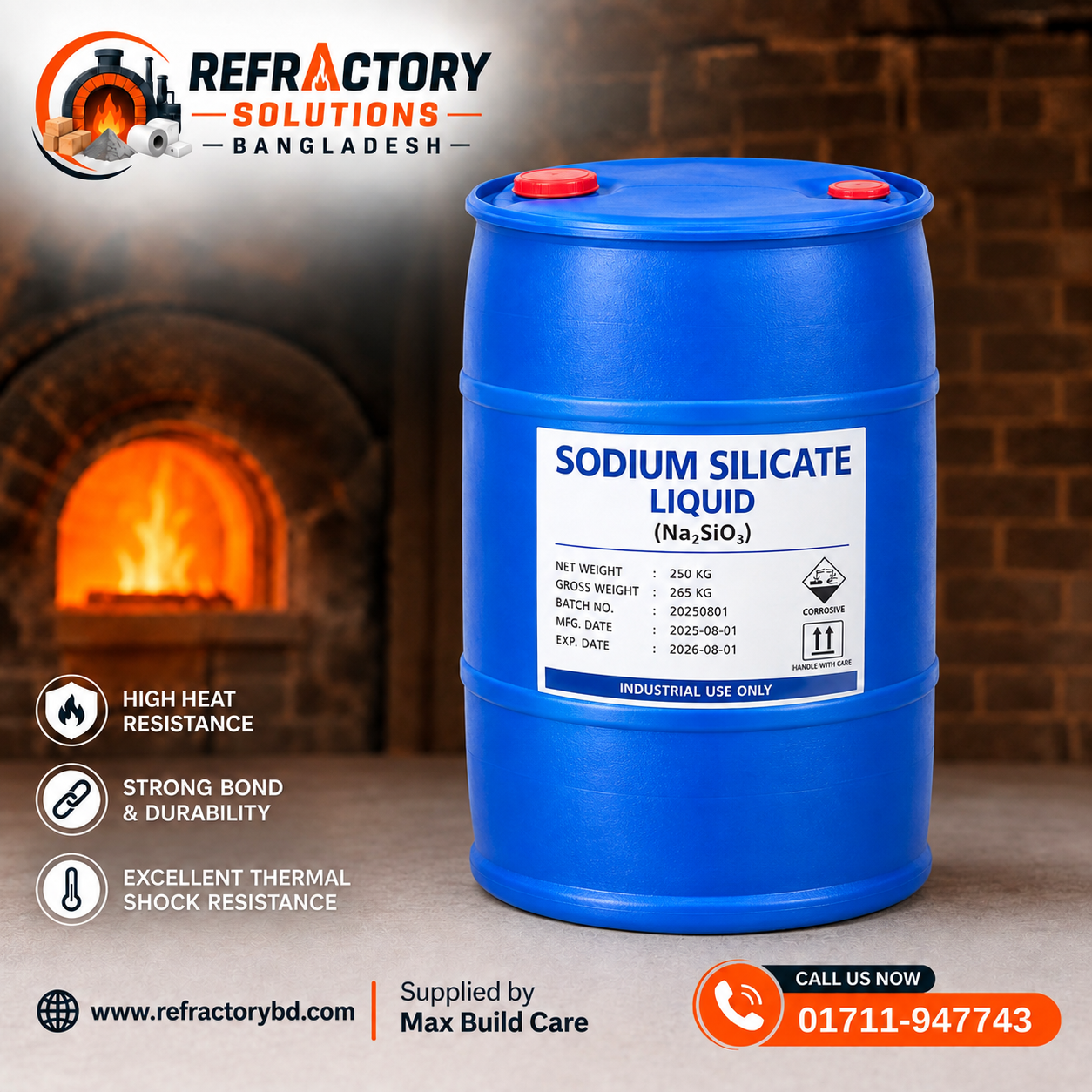
Sodium Silicate (Na₂SiO₃), also known as Water Glass, is an inorganic silicate compound widely used as a binder, bonding agent, and chemical additive in refractory, foundry, construction, and industrial applications. It provides good binding, adhesion, and chemical stability.
Sodium Silicate (Na₂SiO₃), commonly known as Water Glass, is an inorganic silicate compound widely used as a binder, bonding agent, chemical additive, and processing aid across refractory, foundry, construction, ceramics, and various industrial applications. It is available in different grades and forms, including liquid sodium silicate and solid/powder forms, with properties that vary according to the silica-to-sodium oxide ratio and concentration.
Sodium Silicate is produced by combining silica (SiO₂) with sodium oxide (Na₂O) under controlled manufacturing conditions. The resulting silicate compound offers useful binding, adhesion, and chemical characteristics.
In refractory applications, sodium silicate can act as a binder or bonding component in selected refractory formulations. It helps bind refractory particles together and can contribute to the development of a firm structure after appropriate setting or curing.
Chemical Formula: Na₂SiO₃
Common Name: Water Glass
Type: Inorganic Silicate Compound
Category: Refractory Auxiliary Materials
Primary Function: Binder, Bonding Agent & Chemical Additive
Sodium Silicate is used in selected refractory systems where a chemical binder is required. It can be incorporated into suitable refractory mixtures to improve cohesion between refractory particles and assist in forming a stable shaped or monolithic structure.
Its application depends on the refractory formulation and the required setting mechanism. Sodium silicate may be used with refractory aggregates, mineral powders, and other compatible materials to produce specialized refractory products.
For high-temperature applications, the complete refractory formulation must be evaluated because the presence of sodium compounds can influence high-temperature behavior. Therefore, sodium silicate should be selected according to the specific refractory system and manufacturer’s formulation guidelines.
One of the important industrial applications of Sodium Silicate is in the foundry industry, particularly in sand-bonding systems. Sodium silicate can be used as a binder for foundry sand, where it helps provide sufficient cohesion and dimensional stability for producing molds and cores.
When used with an appropriate hardening system, sodium silicate can help the sand achieve the required strength for casting operations. The exact formulation, binder concentration, hardening method, and curing conditions depend on the casting process and required mold properties.
Sodium Silicate is also used in various construction-related applications. It can function as a chemical additive, binder, or hardening component in selected formulations.
It may be used in certain cementitious and mineral-based systems where chemical binding, surface treatment, or densification properties are required. However, the appropriate grade and concentration should be selected according to the specific application.
Beyond refractory and foundry applications, Sodium Silicate is used in several industrial processes. Its combination of sodium and silicate provides useful alkaline and bonding characteristics.
Depending on the grade, it can be used in applications involving detergents, ceramics, paper processing, mineral processing, adhesives, surface treatment, and other chemical formulations.
The SiO₂/Na₂O ratio is an important property because it influences characteristics such as alkalinity, viscosity, solubility, and bonding behavior. Therefore, different grades of sodium silicate may perform differently in practical applications.
Sodium Silicate provides several useful characteristics:
Sodium Silicate is not a single standardized product with identical properties across all suppliers. Important specifications may include SiO₂ content, Na₂O content, SiO₂/Na₂O ratio, solids content, density, viscosity, pH, modulus, and physical form.
For refractory or industrial use, selecting the correct grade is essential. Liquid sodium silicate and solid sodium silicate may require completely different handling and processing methods.
Therefore, the product should always be selected according to the manufacturer’s Technical Data Sheet (TDS) and the requirements of the intended application.
Sodium Silicate should be stored in suitable, properly sealed containers according to the manufacturer’s recommendations. Liquid grades should be protected from unsuitable temperatures and contamination, while solid grades should be kept dry and protected from moisture.
During handling, appropriate personal protective equipment should be used. Users should consult the product’s Safety Data Sheet (SDS) for specific precautions, storage conditions, and handling requirements.
When correctly formulated, Sodium Silicate can provide an effective inorganic bonding mechanism for selected refractory materials. It can help improve green or cured strength and contribute to the structural integrity of refractory mixtures.
Its inorganic nature also makes it useful where an alternative to certain organic binders is required. However, the suitability of sodium silicate depends on the refractory raw materials, service temperature, atmosphere, and desired final properties.
Sodium Silicate (Na₂SiO₃) is a versatile inorganic silicate compound with applications across refractory, foundry, construction, ceramics, and industrial chemical processes. In refractory applications, it can serve as a binder, bonding agent, or auxiliary chemical component, helping improve cohesion and structural integrity in appropriately designed formulations.
For industrial use, the correct grade should be selected based on the required SiO₂/Na₂O ratio, concentration, viscosity, density, and application requirements. Proper formulation, mixing, curing, and handling are important for achieving consistent performance.