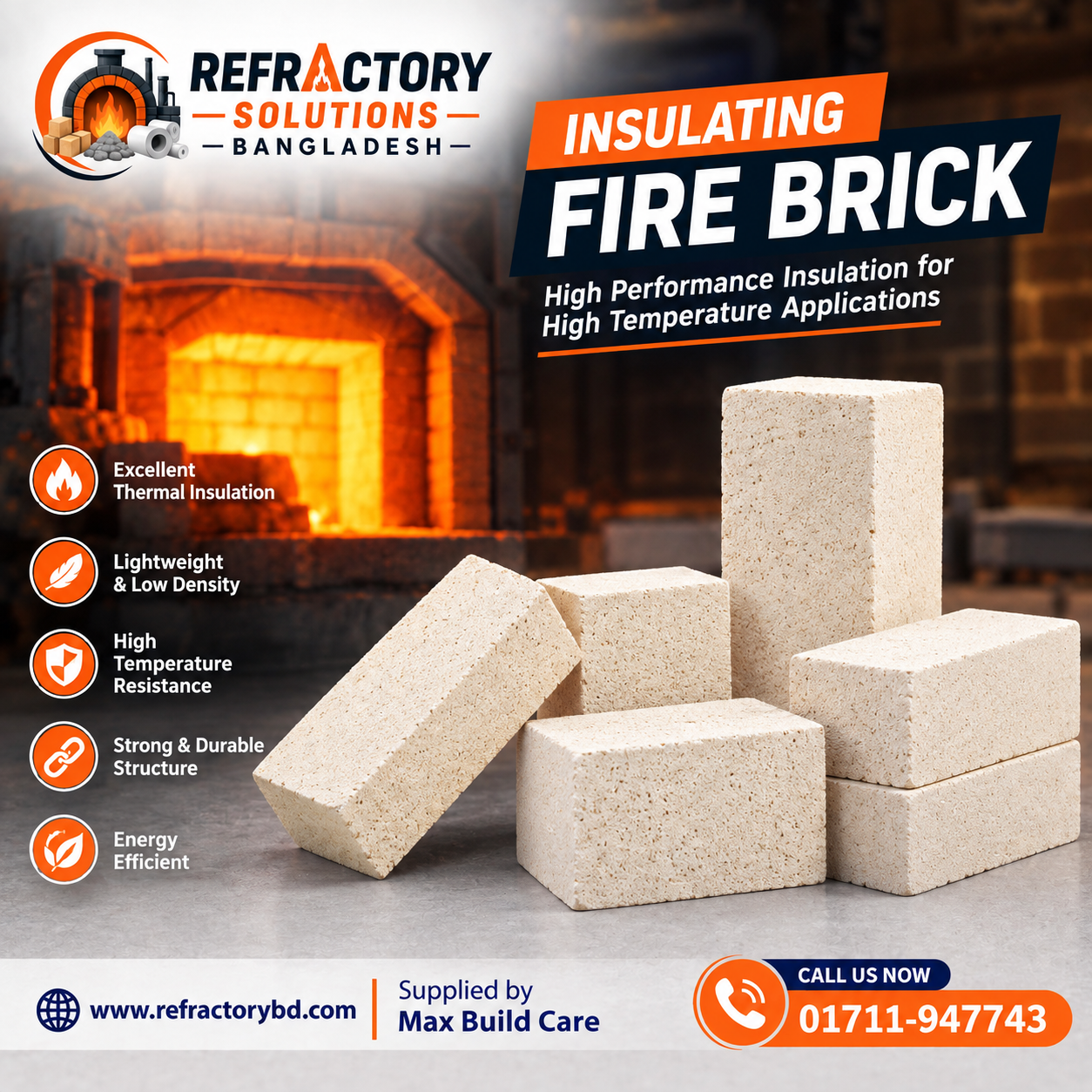
Insulating Fire Brick is a lightweight, high-temperature refractory brick designed to provide excellent thermal insulation and reduce heat loss in furnaces, kilns, ovens, boilers, and other industrial thermal equipment.
Insulating Fire Brick (IFB) is a lightweight refractory brick specially designed to provide effective thermal insulation in high-temperature industrial equipment. Unlike conventional dense firebricks, insulating fire bricks are manufactured with a controlled porous structure that significantly reduces heat transfer while maintaining sufficient thermal stability for their intended service conditions.
These bricks are widely used in furnaces, kilns, ovens, boilers, heaters, heat-treatment equipment, chimneys, and other industrial thermal systems where reducing heat loss and improving energy efficiency are important. Their lightweight construction also helps reduce the overall weight of refractory linings and can simplify installation and maintenance.
Insulating Fire Brick is manufactured from selected refractory and insulating raw materials using processes designed to create a uniform, lightweight structure with low thermal conductivity. The internal pores act as barriers to heat transfer, allowing the brick to provide effective insulation between the hot face and the external structure.
The primary purpose of an insulating fire brick is not simply to withstand heat, but to reduce heat transmission and help maintain the desired temperature inside thermal equipment. For this reason, IFBs are commonly used as backup insulation or, where service conditions permit, as part of the working lining.
The exact composition and performance vary according to the grade. Important parameters can include alumina content, silica content, bulk density, apparent porosity, thermal conductivity, permanent linear change, cold crushing strength, and maximum service temperature.
Insulating Fire Bricks offer several important characteristics for industrial thermal applications:
The lightweight structure makes these bricks considerably easier to handle than many dense refractory bricks. This can be particularly beneficial when constructing large furnace or kiln linings.
The major advantage of Insulating Fire Brick is its ability to reduce heat transfer. The porous structure contains numerous small air-filled spaces that restrict the movement of heat through the material.
By reducing heat loss through furnace walls and other thermal equipment, insulating bricks can help maintain operating temperatures and improve overall thermal efficiency. Depending on the design of the refractory lining, IFBs may also help reduce the external surface temperature of the equipment.
Better insulation can contribute to lower energy consumption, improved temperature control, and reduced thermal stress on surrounding structural components.
Insulating Fire Bricks are widely used in furnace construction, particularly as backup insulation behind dense refractory working linings. They can help reduce heat loss through furnace walls, roofs, and other suitable areas.
Kilns used in ceramics, minerals, heat treatment, and other industries require effective thermal insulation. IFBs can be incorporated into kiln walls, roofs, and selected internal structures where the operating conditions are compatible with the brick grade.
Insulating fire bricks can be used in high-temperature ovens to improve thermal efficiency and maintain stable internal temperatures.
Suitable grades may be used in selected boiler, heater, and thermal-processing equipment insulation systems.
Heat-treatment furnaces require controlled temperature distribution and effective insulation. IFBs can be used as part of the refractory insulation system in suitable applications.
The low-density structure makes IFBs easier to transport, handle, cut, and install compared with many dense refractory bricks.
Their porous structure provides low thermal conductivity, helping reduce heat transfer and energy loss.
By improving furnace and kiln insulation, IFBs can contribute to better energy utilization and temperature retention.
Because they are lightweight, insulating fire bricks can reduce the overall weight of refractory linings and the load imposed on supporting structures.
The relatively lightweight nature of these bricks makes installation and maintenance more convenient.
Properly selected IFBs can provide reliable performance in high-temperature environments within their specified service limits.
Before installation, the supporting surface should be clean, stable, and properly prepared. Bricks should be handled carefully to avoid unnecessary damage, as insulating refractory products can be more fragile than dense firebricks.
The correct refractory mortar or bonding material should be selected according to the brick type and operating conditions. Joints should be properly aligned and kept within the recommended thickness.
Where IFBs are used as backup insulation, they are normally installed behind a suitable dense refractory working layer. The selection of the complete lining system should consider operating temperature, atmosphere, mechanical load, abrasion, thermal cycling, and chemical exposure.
Insulating Fire Bricks should be stored in a dry and protected area. Exposure to rain, moisture, impact, or contamination should be avoided.
Because of their lightweight and porous structure, careful handling is recommended during transportation and installation. Bricks should not be unnecessarily dropped or subjected to excessive mechanical impact.
The exact specifications of an Insulating Fire Brick depend on its grade and manufacturer. Important technical parameters include:
These values should always be verified from the manufacturer’s Technical Data Sheet (TDS), Certificate of Analysis (COA), or product specification before selecting a particular grade.
Insulating Fire Brick is an essential high-temperature insulation material for modern refractory systems where thermal efficiency, low heat loss, and reduced lining weight are important. Its lightweight and porous structure provides effective thermal insulation while offering suitable high-temperature performance for properly selected applications.
IFBs are widely applicable in furnaces, kilns, ovens, boilers, heaters, heat-treatment equipment, and industrial thermal systems. They can be used as backup insulation or, for suitable low-load applications, as part of the primary refractory lining.
For maximum performance, the brick grade should be selected according to the actual operating temperature, mechanical load, thermal cycling, atmosphere, and chemical environment. Correct installation, appropriate refractory mortar, proper joint design, careful handling, and controlled heating are equally important for achieving long service life and reliable thermal insulation.