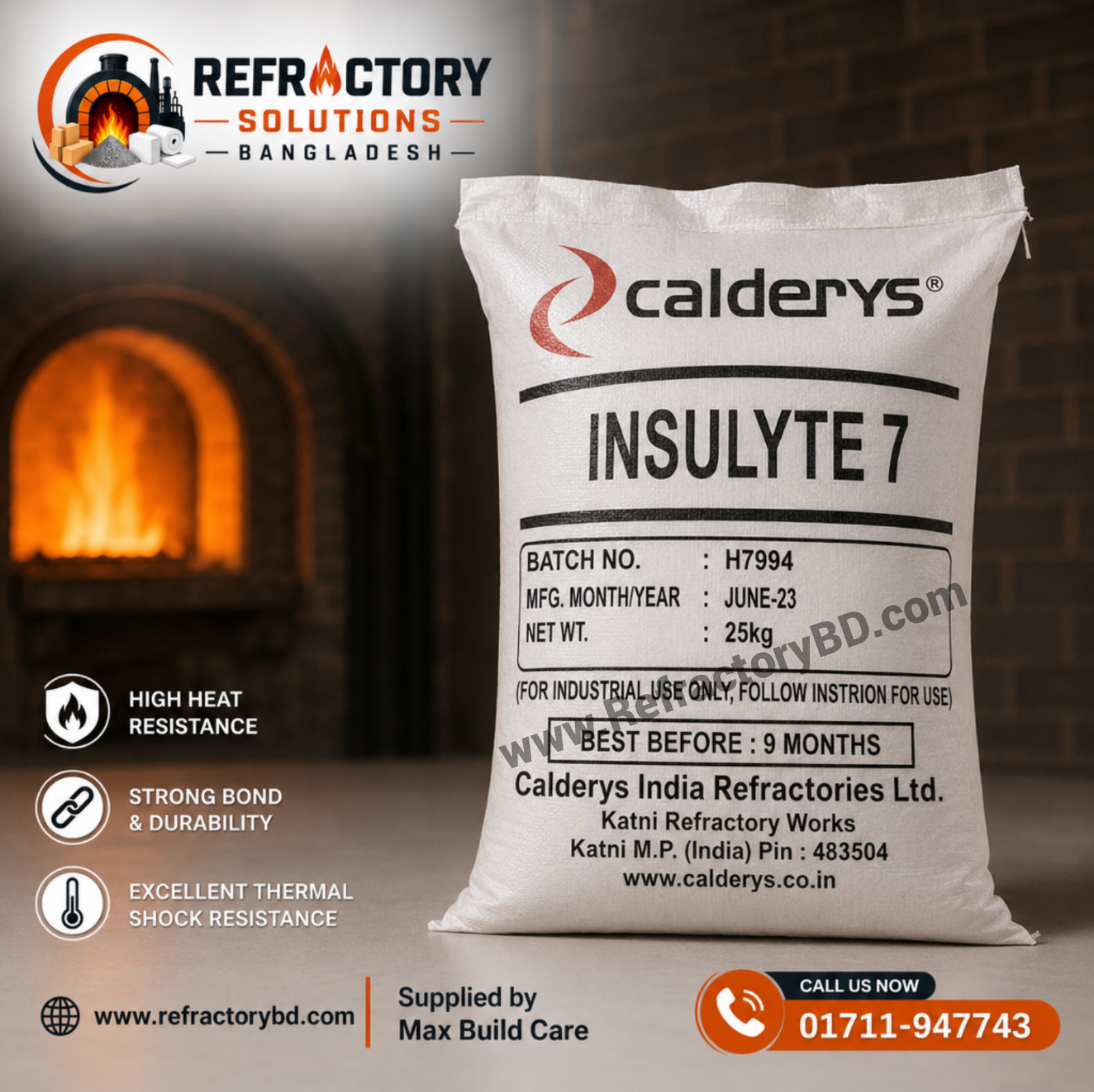
INSULYTE 7 – Low Density Insulating Refractory Castable
INSULYTE 7 is a medium-purity, low-density insulating refractory castable developed for thermal insulation and high-temperature industrial applications. As a monolithic refractory material, it is supplied in dry form and can be installed to create insulating refractory linings in furnaces, kilns, heaters, boilers and other thermal processing equipment. Its low-density formulation helps reduce heat transfer through the refractory lining while maintaining the necessary structural performance for suitable applications.
INSULYTE 7 is classified as a Medium Purity Insulating Castable with Medium Service Temperature, with the manufacturer’s product range placing it in the 1100–1200°C service-temperature category. This makes it suitable for applications where thermal insulation is important and operating conditions fall within the recommended service range.
Low-Density Insulating Performance
One of the key characteristics of INSULYTE 7 is its low dry density. The manufacturer’s technical data sheet specifies a maximum dry density of 0.90 g/cc, with a typical value of approximately 0.84 g/cc after drying at 110°C for 24 hours. A lower-density refractory structure generally helps reduce heat transmission and can contribute to improved thermal efficiency in appropriately designed furnace and equipment linings.
For industrial heating equipment, reducing unnecessary heat loss is an important consideration. Insulating castables such as INSULYTE 7 can be used as part of a refractory lining system to provide thermal insulation behind suitable hot-face materials or in applications where the operating conditions permit direct use.
Refractory Monolithic Material
Unlike conventional refractory bricks, INSULYTE 7 is supplied as a monolithic refractory castable. This allows the material to be installed into required shapes and areas rather than relying entirely on individually shaped bricks.
The product uses a hydraulic bond and the manufacturer’s listed installation method is tamping. Proper installation is important because the final performance of an insulating castable depends not only on its dry properties but also on mixing, placement, compaction, drying and heating procedures.
Thermal and Mechanical Properties
INSULYTE 7 is designed for thermal-insulation applications while providing sufficient mechanical strength for its intended service conditions.
According to the manufacturer’s published technical data, the typical cold crushing strength is approximately 15.4 kg/cm² after drying at 110°C for 24 hours and approximately 8.3 kg/cm² after heating at 1100°C for 3 hours. The typical refractoriness is listed as Orton Cone 12 / approximately 1337°C.
The technical data also lists a typical thermal conductivity of approximately 0.18 kcal/m/hr/°C at 500°C. Lower thermal conductivity is an important characteristic for insulating refractory materials because it helps limit heat flow through the lining.
Typical Industrial Applications
INSULYTE 7 can be considered for a variety of industrial thermal applications where a low-density insulating castable is required within its recommended service conditions.
Potential applications include:
- Industrial furnaces
- Heating furnaces
- Kilns
- Boilers
- Heaters
- Thermal processing equipment
- Furnace insulation layers
- Kiln insulation systems
- Heat-treatment equipment
- Industrial thermal units
- Back-up insulation systems
The exact location of the material within a refractory lining should be selected according to the equipment design, operating temperature, atmosphere, mechanical load and compatibility with other refractory materials.
Advantages of INSULYTE 7
🔥 Thermal Insulation
Its low-density formulation is designed to provide thermal insulation and reduce heat transfer through suitable refractory structures.
⚙️ Low Dry Density
The published typical dry density of approximately 0.84 g/cc makes it a lightweight insulating refractory material.
🧱 Monolithic Installation
As a castable, it can be installed in areas where conventional refractory bricks may not be practical.
🌡️ Medium-Temperature Insulating Application
The manufacturer’s product range categorizes INSULYTE 7 within the 1100–1200°C medium service-temperature insulating castable range.
💪 Suitable Mechanical Performance
It provides the mechanical strength specified for its intended insulating applications, subject to correct installation and service conditions.
Installation
INSULYTE 7 is supplied as a dry refractory mix and the manufacturer’s data identifies tamping as the installation method. Correct installation is essential for achieving the intended density, strength and insulation performance.
The material should be mixed and installed according to the manufacturer’s recommended procedure. Proper compaction, controlled drying and appropriate initial heating are important considerations when commissioning an insulating refractory lining.
Product Specification
| Specification |
INSULYTE 7 |
| Product Type |
Insulating Refractory Castable |
| Product Class |
Refractory Monolithic |
| Type |
Low Density Insulating Castable |
| Purity Class |
Medium Purity |
| Bond |
Hydraulic |
| Installation |
Tamping |
| Service Temperature Class |
1100–1200°C |
| Dry Density, Typical |
0.84 g/cc |
| Dry Density, Specification |
0.90 g/cc Max. |
| Refractoriness, Typical |
1337°C / Orton 12 |
| Thermal Conductivity at 500°C |
0.18 kcal/m/hr/°C Typical |
Technical values are based on the manufacturer’s published product data and should be checked against the latest TDS/COA supplied with the material.
INSULYTE 7 in Bangladesh
For industrial projects in Bangladesh requiring low-density insulating refractory castables, INSULYTE 7 can be specified according to the required application, quantity, installation method and operating temperature. Before purchasing, users should verify the latest technical datasheet and ensure that the product is appropriate for the intended refractory lining design.