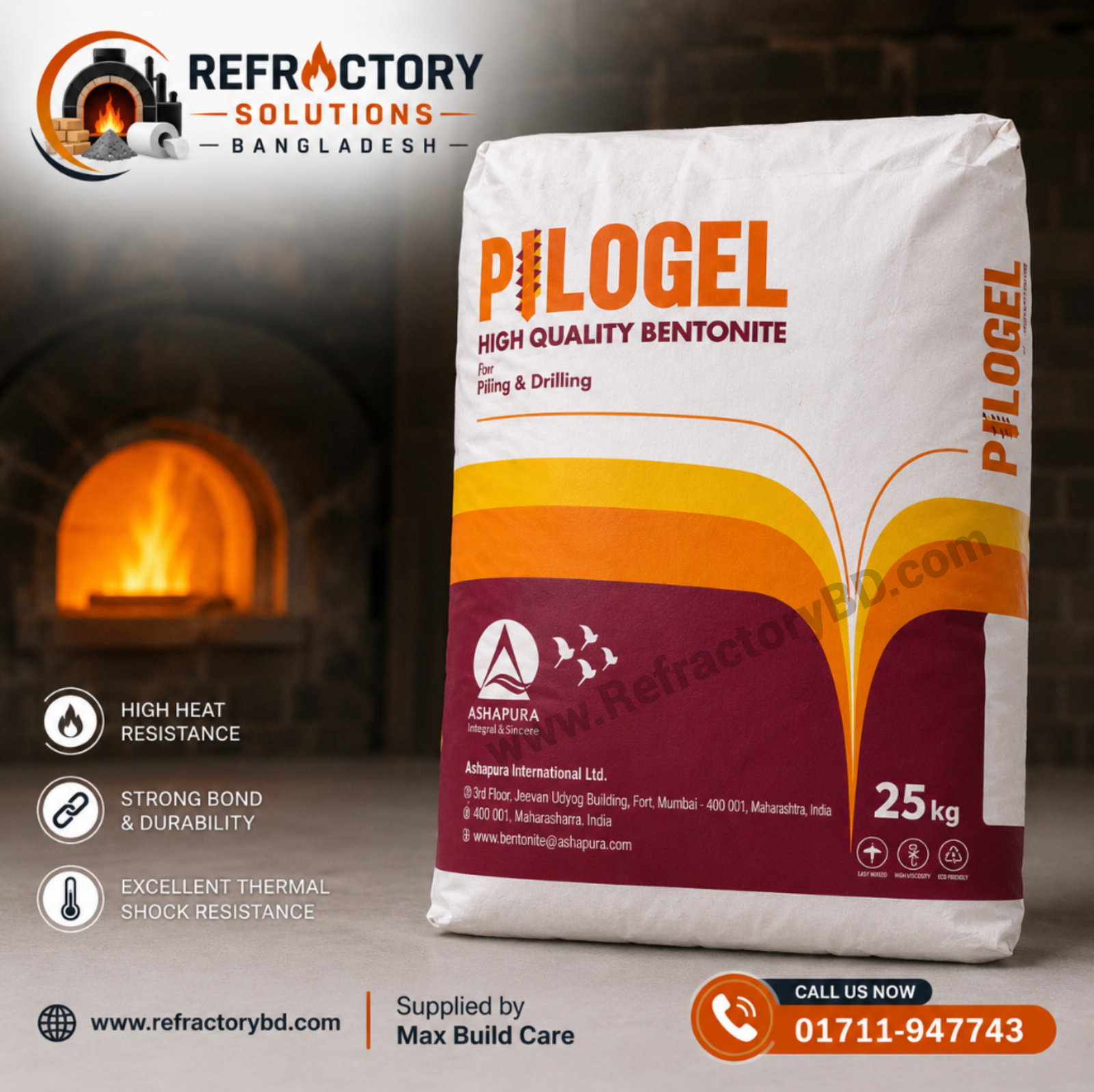
Bentonite Powder is a naturally occurring clay mineral primarily composed of Montmorillonite [Na,Ca)₀.₃₃(Al,Mg)₂Si₄O₁₀(OH)₂·nH₂O]. It offers excellent swelling, water absorption, binding and sealing properties, making it suitable for refractory, drilling, foundry, construction and industrial applications.
Bentonite Powder is a naturally occurring, highly absorbent clay mineral widely used across refractory, drilling, foundry, construction, civil engineering, and various industrial applications. Its primary active mineral is generally Montmorillonite, which gives bentonite its characteristic swelling, water absorption, binding, suspension, sealing, and rheological properties. Depending on its mineral composition and processing, bentonite is commonly classified as Sodium Bentonite or Calcium Bentonite.
Bentonite Powder is produced by processing naturally occurring bentonite clay through controlled drying, grinding, and sieving processes. The resulting fine powder can be easily mixed with water or incorporated into different industrial formulations.
One of the most important characteristics of bentonite is its ability to absorb water and swell. When hydrated, sodium bentonite can form a viscous gel-like suspension that provides excellent sealing and suspension properties. These characteristics make bentonite particularly useful where water retention, particle suspension, binding, or permeability control is required.
Main Mineral: Montmorillonite
Chemical Formula: Variable; commonly represented for montmorillonite as (Na,Ca)₀.₃₃(Al,Mg)₂Si₄O₁₀(OH)₂·nH₂O
Product Form: Fine Powder
Type: Natural Clay Mineral
Bentonite Powder offers several functional properties that make it valuable for industrial applications. Its high water absorption capacity allows it to expand and form a stable gel when properly hydrated. It also has strong binding characteristics, which are particularly useful in foundry and refractory-related processes.
The suspension capability of bentonite allows fine particles to remain dispersed in water-based systems. Its sealing properties are also important in applications where reducing water or fluid movement through soil or other porous materials is required.
Depending on the grade, bentonite may provide:
Actual performance depends on the bentonite source, mineralogy, processing method, particle size, moisture content, and grade.
Bentonite Powder can be used as a binding or additive material in selected refractory formulations. Its binding properties can assist in improving the cohesion and workability of certain mixtures.
However, bentonite should not automatically be considered a primary refractory raw material for every refractory formulation. Its suitability depends on the specific formulation, required temperature performance, chemical compatibility, and manufacturer’s technical requirements.
For refractory applications, the appropriate grade should therefore be selected based on the required Al₂O₃, SiO₂, Fe₂O₃, moisture, swelling index, particle size, and other relevant properties.
Sodium Bentonite is widely used in drilling and piling operations because of its ability to form a stable suspension when mixed with water. The resulting bentonite slurry can help suspend drilled particles and provide support to borehole walls during appropriate drilling operations.
It is commonly associated with:
The required bentonite grade should be selected according to the drilling method, soil conditions, slurry requirements, and project specifications.
Bentonite Powder is also widely used in foundry operations as a bonding material for molding sand. When mixed with suitable sand and water, bentonite can help improve mold cohesion and strength.
Its binding capability allows molding sand to maintain the required shape during handling and casting. Proper bentonite selection can contribute to mold stability, surface quality, and process consistency.
Bentonite’s swelling and sealing characteristics make it useful in several construction and geotechnical applications. It can be used in selected waterproofing, sealing, slurry, and soil-related systems.
Sodium Bentonite is particularly valued where controlled swelling and low permeability are required. The actual application method and grade should always follow the relevant project specification.
Bentonite is available in different grades depending on its intended application. Important parameters can include montmorillonite content, swelling index, viscosity, moisture, particle size, gel strength, filtrate loss, pH, and chemical composition.
For commercial and industrial applications, buyers should select the grade according to the specific requirements of the project rather than relying solely on the generic name “Bentonite Powder.”
Bentonite Powder should be stored in a dry, covered, and well-ventilated area. The product should be protected from moisture before use because premature exposure to water can affect its handling and performance.
Bags should preferably be kept off the floor and protected from rain, groundwater, and excessive humidity. During handling, appropriate dust-control and personal protective measures should be followed.
Bentonite Powder is a versatile natural clay mineral with valuable swelling, absorption, binding, suspension, and sealing characteristics. These properties make it suitable for a wide range of applications, including refractory formulations, drilling and piling, foundry molding, construction, civil engineering, and other industrial processes.
For best results, the bentonite grade should be matched to the intended application. Technical parameters such as swelling capacity, viscosity, moisture, particle size, montmorillonite content, and chemical composition should be confirmed through the relevant Technical Data Sheet (TDS) or Certificate of Analysis (COA) before industrial use.