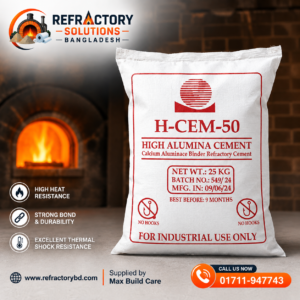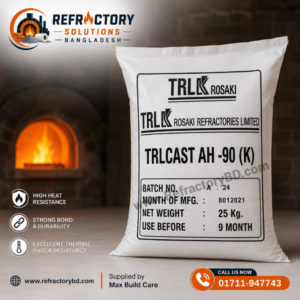
ACE Refractories Fire Cement is a heat-resistant refractory cement designed for bonding and repairing refractory bricks, firebricks, furnace linings, fireplaces, kilns, and other high-temperature applications. It provides strong adhesion and reliable performance under elevated temperatures.
ACE Refractories FIRE CEMENT is a specialized refractory cement designed for high-temperature applications where ordinary Portland cement cannot provide the required heat resistance and durability. It is primarily used for bonding, jointing, patching, sealing, and repairing refractory materials such as firebricks and refractory linings in furnaces, kilns, fireplaces, chimneys, boilers, and other thermal equipment.
FIRE CEMENT provides a practical solution for refractory construction and maintenance work where a heat-resistant bonding material is required. Its cementitious form allows it to be applied to refractory surfaces and joints, helping create a strong and continuous refractory assembly.
ACE Refractories FIRE CEMENT is intended for applications exposed to elevated temperatures. When properly applied and dried, refractory cement helps maintain the integrity of refractory joints and connections during thermal operation.
Unlike conventional construction cement, fire cement is formulated specifically for refractory applications. It is used where the bonding material itself needs to withstand heat and remain compatible with refractory bricks and other heat-resistant materials.
The exact maximum service temperature, chemical composition, setting characteristics, and mechanical properties depend on the specific ACE FIRE CEMENT grade. For technical specifications, the manufacturer’s latest TDS (Technical Data Sheet) should be consulted.
One of the principal uses of FIRE CEMENT is bonding refractory and firebricks. During furnace and kiln construction, individual bricks need to be properly joined to form a stable refractory lining. FIRE CEMENT can be used as a refractory jointing material to fill gaps between suitable refractory units.
It can be particularly useful in applications involving:
Proper joint thickness and installation technique should always follow the product manufacturer’s recommendations.
Industrial furnaces and kilns operate under demanding thermal conditions. Their refractory lining protects the structural shell and surrounding components from direct exposure to heat.
ACE FIRE CEMENT can be used for selected refractory construction, jointing, maintenance, and repair applications in:
The appropriate refractory cement should be selected according to operating temperature, refractory material, thermal cycling, chemical exposure, and the specific installation requirements.
Refractory linings can develop cracks, open joints, damaged areas, or localized deterioration during continuous operation. FIRE CEMENT can be useful for certain maintenance and repair requirements where a compatible refractory bonding or patching material is needed.
Before repairing an existing lining, loose, damaged, or contaminated material should be removed and the surface properly prepared. The repair method should be selected according to the condition of the refractory lining and the manufacturer’s instructions.
A good refractory cement should provide effective adhesion between compatible refractory components while maintaining stability during heating and cooling cycles. ACE FIRE CEMENT is designed for refractory bonding applications where ordinary cement is unsuitable because of elevated temperature exposure.
Its use can help create properly connected refractory components and reduce weaknesses associated with poorly formed joints.
The application procedure depends on the particular FIRE CEMENT formulation. Generally, the refractory surfaces should be clean, sound, and free from loose particles, dust, grease, and other contaminants.
The cement should be prepared and applied according to the manufacturer’s recommended procedure. Consistent joint thickness and proper surface contact are important for achieving satisfactory results.
Where the product is supplied ready-to-use, unnecessary addition of water or other materials should be avoided unless specifically permitted by the manufacturer.
Proper drying is an important part of refractory installation. Newly applied refractory cement should not immediately be exposed to intense heat unless the manufacturer’s instructions specifically allow it.
Controlled drying and gradual heating help minimize the risk of moisture-related cracking, spalling, or other damage. For furnace and kiln applications, the initial heat-up should follow the recommended refractory dry-out procedure.
ACE Refractories FIRE CEMENT offers several practical benefits for refractory construction and maintenance:
The performance of refractory cement depends on more than its temperature rating. Before selecting ACE FIRE CEMENT for a project, users should consider the operating temperature, type of refractory brick, joint thickness, heating cycle, mechanical conditions, chemical environment, and installation method.
Important technical parameters may include:
Product Type: Refractory Fire Cement
Application: Bonding, Jointing & Repair
Physical Form: Grade dependent
Colour: Grade dependent
Setting Characteristics: Grade dependent
Maximum Service Temperature: Grade dependent
Chemical Composition: Manufacturer specification
Bond Strength: Grade dependent
Installation Method: As recommended by manufacturer
For project-specific use, the manufacturer’s TDS, MSDS, and COA should be reviewed before application.
FIRE CEMENT should be stored according to the manufacturer’s recommendations. Dry products should be protected from moisture, while ready-to-use products should remain properly sealed when not in use.
Workers should use appropriate personal protective equipment during handling and application. The product’s safety data sheet should be consulted for detailed handling, storage, and occupational safety requirements.
ACE Refractories FIRE CEMENT can be positioned as a heat-resistant refractory bonding and repair material for industrial and commercial applications in Bangladesh. It can be suitable for furnace, kiln, boiler, fireplace, chimney, oven, and other high-temperature refractory work when the selected grade matches the operating conditions.
In summary, ACE Refractories FIRE CEMENT is a specialized refractory cement developed for high-temperature bonding, jointing, sealing, and selected repair applications. It provides a practical refractory solution for maintaining the integrity of firebrick and refractory linings in furnaces, kilns, fireplaces, chimneys, boilers, and other thermal equipment.