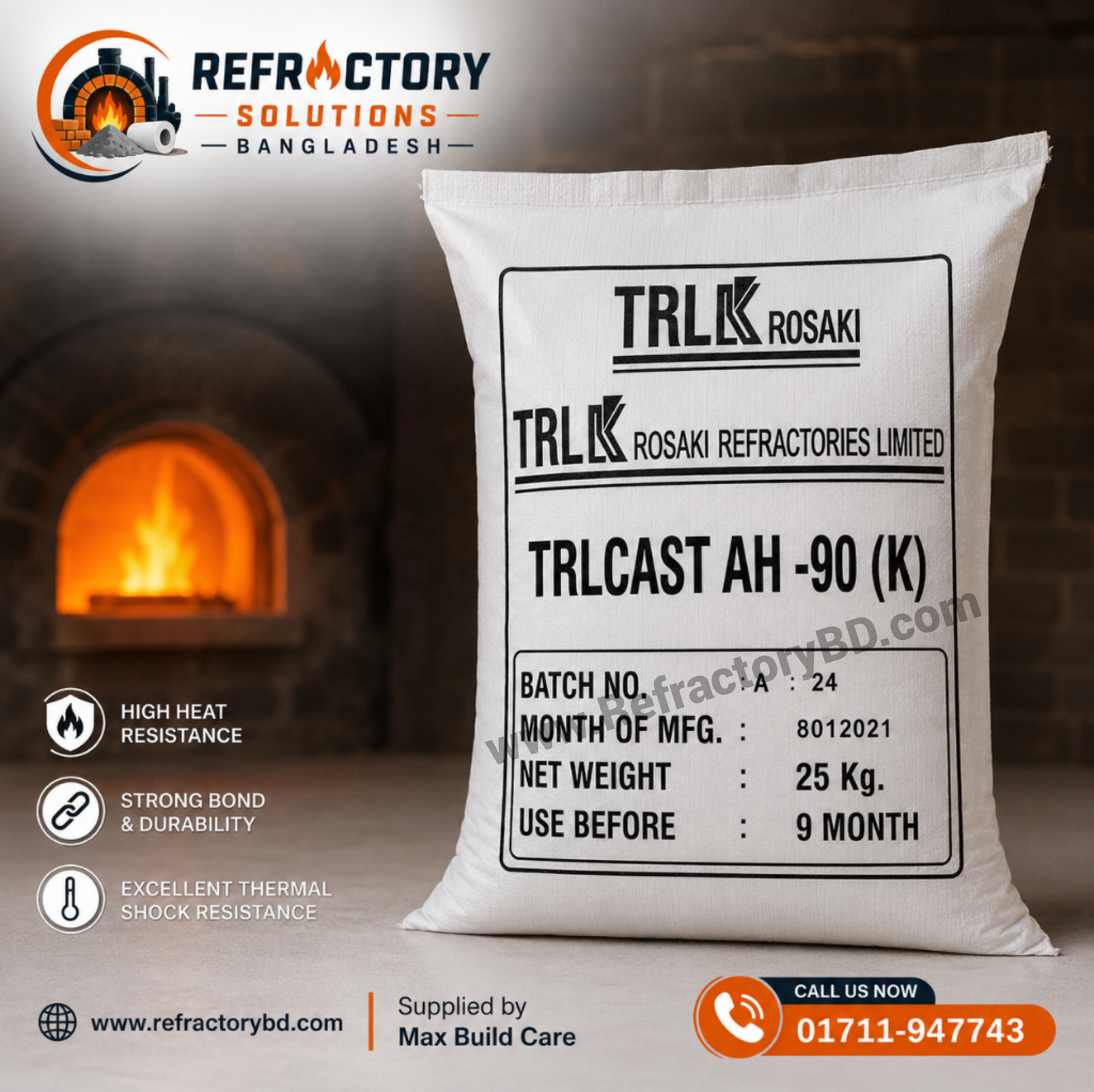
TRLCAST AH-90 (K) – High Alumina Refractory Castable
TRLCAST AH-90 (K) is a high-alumina refractory castable designed for demanding high-temperature industrial applications. As a monolithic refractory material, it is used to construct, repair, and maintain refractory linings in furnaces, kilns, boilers, heaters, and other thermal processing equipment. Its alumina-based refractory formulation is intended to provide good resistance to high temperatures, thermal exposure, and mechanical stresses encountered in industrial operations.
Product Overview
Unlike conventional refractory bricks, castables are supplied as dry granular or powdered materials that are mixed and installed directly at the required location. This makes them particularly useful for complex shapes, repairs, equipment sections, and areas where traditional brick installation may be difficult.
TRLCAST AH-90 (K) can be used as part of a properly designed refractory lining system where high alumina performance is required. The product should be selected according to the operating temperature, furnace atmosphere, mechanical conditions, chemical exposure, and substrate requirements.
Product Name: TRLCAST AH-90 (K)
Product Type: High Alumina Refractory Castable
Main Component: Al₂O₃ (Alumina)
Category: Monolithic Refractories
Primary Use: High-Temperature Refractory Lining
High Alumina Performance
High-alumina refractory castables are formulated with alumina-rich refractory raw materials to provide enhanced performance in high-temperature environments. Alumina contributes to refractoriness and thermal stability, making high-alumina castables suitable for applications where ordinary refractory concretes may not provide the required performance.
TRLCAST AH-90 (K) is designed for use where a durable monolithic refractory lining is required. When correctly installed and properly dried, the castable can provide a continuous refractory structure with good resistance to thermal exposure.
The exact alumina percentage, maximum service temperature, bulk density, porosity, cold crushing strength, and other technical values should be confirmed from the manufacturer’s current TDS (Technical Data Sheet) or COA (Certificate of Analysis).
Furnace Applications
TRLCAST AH-90 (K) can be considered for suitable furnace lining applications. Industrial furnaces are exposed to continuous high temperatures and may also experience abrasion, mechanical impact, thermal cycling, and chemical attack.
A high-alumina castable can provide a strong refractory layer that protects the underlying equipment structure from excessive heat. It may be used for furnace floors, walls, hearth areas, selected hot-face sections, and maintenance or repair zones, depending on the specific grade and manufacturer’s recommendations.
Kiln and Thermal Equipment Applications
The product can also be used in appropriate kiln and thermal-processing applications. Kilns commonly operate through repeated heating and cooling cycles, making thermal stability an important consideration when selecting refractory materials.
TRLCAST AH-90 (K) may be suitable for refractory construction or repair in kilns, heaters, boilers, industrial ovens, and other high-temperature equipment where a castable lining is required.
Correct product selection should take into account the actual service temperature and operating environment.
Installation
Proper installation is essential to achieving the expected performance of a refractory castable. Before installation, the substrate should be properly prepared and free from loose material, dust, oil, grease, and other contaminants.
The castable should be mixed using the manufacturer’s recommended water or liquid addition and mixing procedure. Excessive water should be avoided because uncontrolled water addition can negatively affect the final properties of the installed refractory.
Depending on the installation method and product specification, the material may be placed by casting, vibration, tamping, or another approved technique. Proper compaction is important to minimize voids and achieve a uniform refractory structure.
After installation, appropriate curing and controlled dry-out are essential. Rapid heating of a newly installed castable can cause steam pressure, cracking, or other damage. The manufacturer’s recommended curing and dry-out schedule should therefore be followed carefully.
Key Benefits
TRLCAST AH-90 (K) offers the key characteristics expected from a high-alumina monolithic refractory castable, including:
- High-temperature refractory performance
- Alumina-based refractory composition
- Good thermal stability
- Durable monolithic lining structure
- Suitable for furnace and kiln applications
- Useful for refractory construction and repair
- Can be applied to complex areas
- Reduced dependence on conventional brick jointing
- Suitable for industrial thermal equipment
Quality and Technical Selection
Refractory castables are available in different grades for different service conditions. Important parameters for evaluating a high-alumina castable may include Al₂O₃ content, SiO₂ content, Fe₂O₃ content, bulk density, apparent porosity, cold crushing strength, permanent linear change, thermal conductivity, refractoriness, and maximum service temperature.
For TRLCAST AH-90 (K), these specifications should be obtained from the manufacturer’s official technical documentation rather than assumed from the product name. This is particularly important when the material is being specified for a critical furnace, kiln, boiler, or industrial lining.
Storage and Handling
TRLCAST AH-90 (K) should be stored in a dry and protected location. The material should be kept away from moisture and direct exposure to rain or humid conditions. Bags should remain properly sealed until required for installation.
During mixing and installation, appropriate personal protective equipment should be used, and the manufacturer’s Safety Data Sheet (SDS) should be followed.
Conclusion
TRLCAST AH-90 (K) is a high-alumina refractory castable intended for high-temperature industrial refractory lining applications. Its monolithic format makes it suitable for construction, maintenance, and repair work in furnaces, kilns, boilers, heaters, ovens, and other thermal processing equipment.
With proper material selection, mixing, installation, curing, and controlled dry-out, a high-alumina castable can provide a durable refractory lining capable of withstanding demanding thermal conditions.