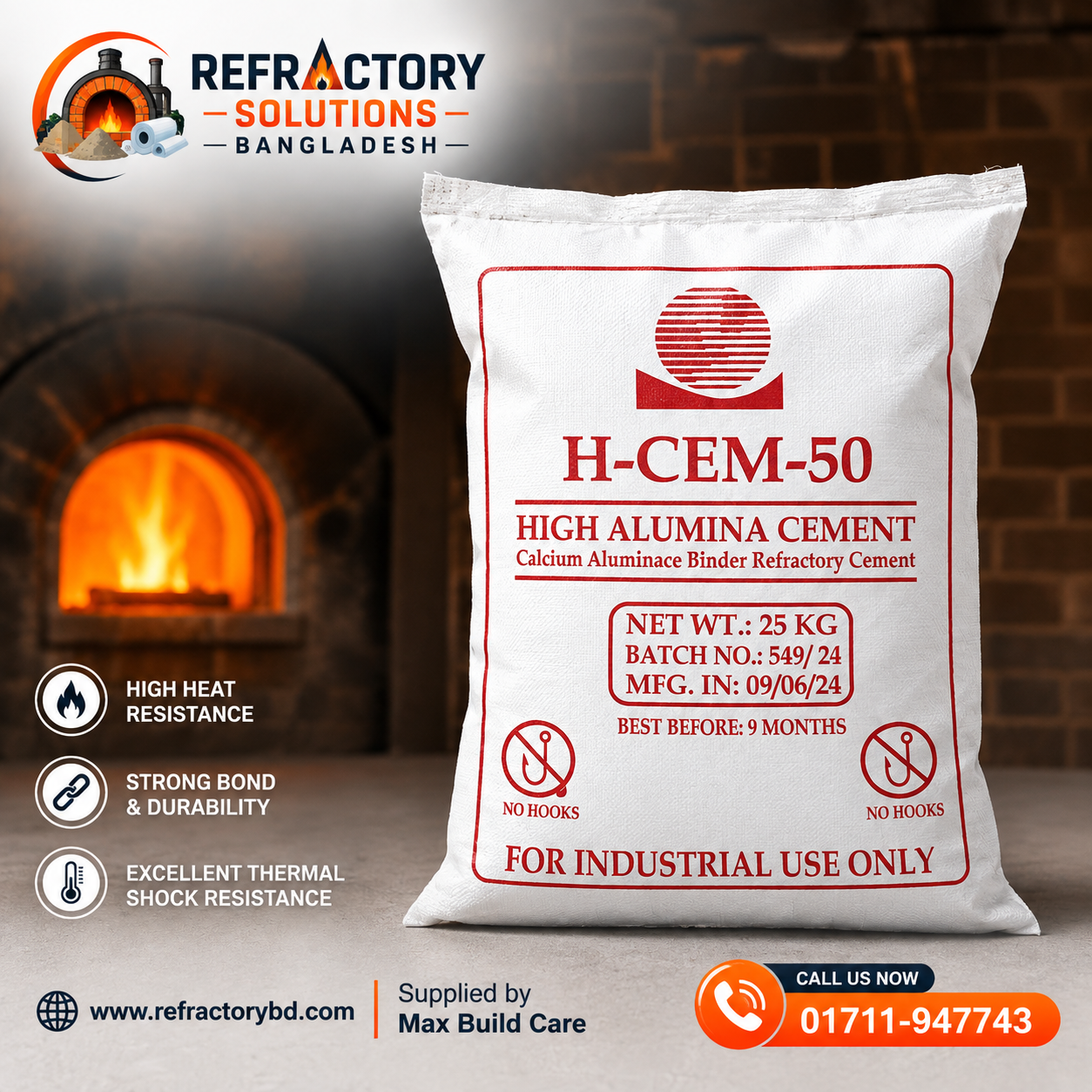
H-CEM-50 High Alumina Cement is a specialized refractory binder designed for high-temperature applications. It provides excellent heat resistance, rapid strength development, and good thermal stability, making it suitable for refractory castables, furnace linings, kilns, boilers, and other industrial refractory applications.
H-CEM-50 High Alumina Cement is a specialized refractory cement designed to provide reliable bonding and strength in high-temperature applications. High alumina cement, also known as calcium aluminate cement, is widely used as a binder in refractory formulations where conventional Portland cement may not provide the required performance under elevated temperatures.
H-CEM-50 is suitable for the production and installation of various monolithic refractory materials, including refractory castables, furnace linings, kiln linings, boiler linings, and other heat-resistant systems. Its high-alumina binder technology helps develop strength during curing and contributes to the refractory structure during subsequent heating.
H-CEM-50 is designed for applications where a combination of heat resistance, bonding performance, and strength development is required. It can be used as a refractory binder in appropriately designed formulations.
Key features include:
Actual chemical composition, setting characteristics, strength values, and temperature performance should be confirmed using the manufacturer’s latest Technical Data Sheet (TDS).
High Alumina Cement is an important binder used in monolithic refractory technology. It is based primarily on calcium aluminate phases and is formulated to provide strength and bonding properties suitable for refractory applications.
When combined with suitable refractory aggregates and other ingredients, H-CEM-50 can be used to formulate castable refractory systems. The final performance of the castable depends not only on the cement but also on aggregate selection, particle-size distribution, water addition, additives, curing conditions, drying, and firing.
For this reason, H-CEM-50 should be incorporated into a properly designed refractory formulation according to the manufacturer’s recommendations.
One of the most important applications of H-CEM-50 is as a binder in refractory castables. Castables are monolithic refractory materials that are installed by mixing, placing, casting, or other suitable methods.
H-CEM-50 helps bind the refractory aggregates and fine powders together during the curing stage. After appropriate drying and heating, the refractory system develops the required structure for high-temperature service.
It can be used in different castable formulations depending on the required alumina level, density, strength, thermal performance, abrasion resistance, and operating environment.
High-temperature furnaces and kilns require refractory linings capable of protecting the supporting structure from heat and thermal stress. H-CEM-50 can be used as a binder in refractory mixtures intended for selected furnace and kiln applications.
Potential application areas include furnace floors, walls, roofs, burner surrounds, kiln linings, combustion chambers, and localized refractory repair systems.
The suitability of the cement depends on the actual operating temperature, atmosphere, mechanical loading, chemical exposure, and refractory formulation.
A major advantage of high alumina cement is its ability to develop bonding and strength after mixing and curing. This makes it particularly useful for monolithic refractory systems.
The final mechanical performance depends on several factors, including cement dosage, water-to-cement ratio, aggregate type, particle-size distribution, curing temperature, drying procedure, and heat treatment.
Excessive water addition should generally be avoided because unnecessary water can increase porosity and may negatively affect the final properties of the refractory castable.
Refractory systems based on high alumina cement are designed for applications involving elevated temperatures. The cement contributes to the bonding structure of the castable and is selected according to the intended refractory service conditions.
Proper formulation is essential because the high-temperature behavior of a castable is determined by the complete refractory system rather than by the cement alone.
Controlled drying and gradual heating are also important to minimize the risk of cracking, spalling, or damage caused by rapid moisture removal.
H-CEM-50 can be incorporated into suitable refractory formulations containing materials such as high-alumina aggregates, calcined bauxite, fireclay, refractory grog, alumina-rich fines, and other compatible refractory raw materials.
The selection of aggregates and additives should be based on the required performance and chemical compatibility. A professionally designed formulation can optimize workability, strength, density, thermal performance, and durability.
H-CEM-50 High Alumina Cement can be considered for a broad range of industrial refractory applications, including:
H-CEM-50 should be stored in a clean, dry, and moisture-protected environment. The original packaging should remain properly sealed until use. Exposure to humidity or water before application may affect the material’s quality and performance.
During handling and mixing, suitable personal protective equipment and standard industrial safety procedures should be followed.
For industrial procurement and quality control, users should review the manufacturer’s current technical documentation. Important parameters may include Al₂O₃ content, CaO content, SiO₂ content, Fe₂O₃ content, bulk density, setting time, water requirement, cold crushing strength, particle size, refractoriness, and other relevant physical and chemical properties.
These values should be matched with the requirements of the intended refractory application.
H-CEM-50 – High Alumina Cement is a specialized refractory binder suitable for high-temperature monolithic refractory applications. Its bonding capability, strength development, and compatibility with suitable refractory aggregates make it an important material for producing refractory castables and other heat-resistant systems.
It can be considered for furnaces, kilns, boilers, foundries, cement plants, steel industries, and various other industrial applications. For optimum results, H-CEM-50 should be used according to the manufacturer’s recommended formulation, mixing procedure, curing conditions, drying schedule, and technical specifications.
Proper material selection, accurate proportioning, controlled water addition, professional installation, and appropriate dry-out procedures are essential to achieve reliable and durable refractory performance.