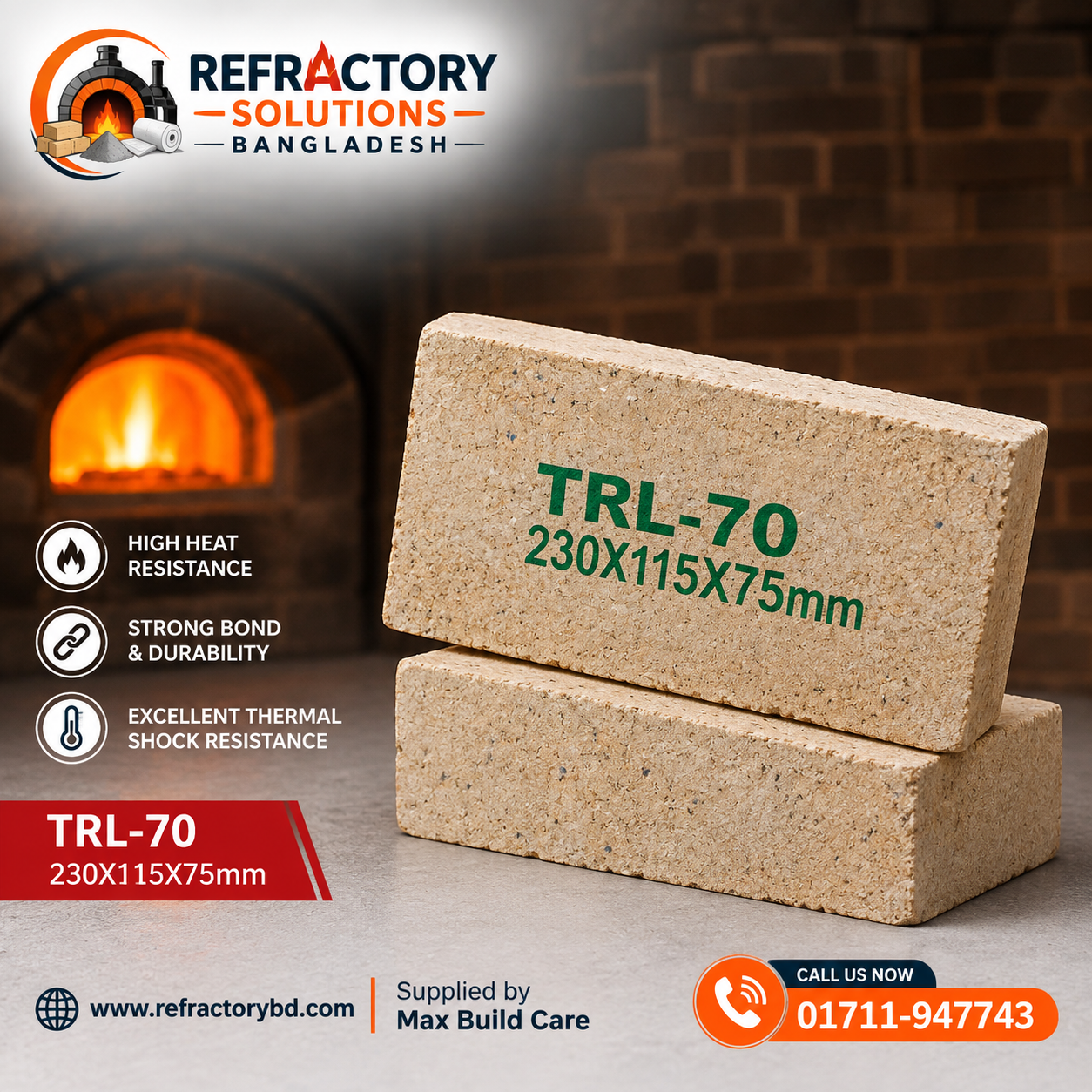
TRL-70 is a high-quality refractory brick designed for high-temperature industrial applications, offering excellent thermal resistance, mechanical strength, dimensional stability, and durability in furnaces, kilns, boilers, and other heat-intensive environments.
TRL-70 230×115×75 mm Refractory Brick is a specialized refractory material designed for use in high-temperature industrial environments where conventional construction bricks are not suitable. With a standard dimension of 230 × 115 × 75 mm, this refractory brick is suitable for various furnace, kiln, heating chamber, boiler, and industrial refractory lining applications.
Refractory bricks play an important role in protecting industrial equipment and structures from prolonged exposure to elevated temperatures. They are commonly used to construct internal linings that help contain heat and reduce the direct thermal impact on the outer structure of furnaces, kilns, and other thermal processing equipment. TRL-70 can be selected for suitable refractory construction, maintenance, and repair applications according to the operating conditions and technical requirements of the project.
The TRL-70 refractory brick has a nominal size of 230 mm × 115 mm × 75 mm. This standard rectangular format makes the brick convenient for installation, replacement, maintenance, and refractory wall construction.
The standard dimensions also allow contractors and industrial users to plan brick layouts efficiently. Depending on the design of the furnace or kiln, the bricks can be arranged to create suitable refractory walls, chambers, and lining structures.
Refractory bricks are primarily used where materials must withstand demanding thermal environments. TRL-70 230×115×75 mm can be considered for a variety of industrial applications where a dedicated refractory material is required.
Typical application areas may include:
The suitability of the brick should always be evaluated according to the actual operating temperature, thermal cycling, mechanical load, atmosphere, chemical exposure, and other conditions of the application.
Furnaces and kilns operate under demanding thermal conditions, making proper refractory lining essential for efficient and reliable operation. A refractory lining helps protect the main equipment structure from direct exposure to high temperatures and supports controlled heat containment within the working chamber.
TRL-70 230×115×75 mm may be used in appropriate furnace and kiln lining systems where its grade and technical characteristics meet the requirements of the application. Proper brick arrangement and installation are important for maintaining the integrity of the refractory lining during operation.
Industrial refractory materials must maintain their structural integrity under demanding operating conditions. In addition to temperature resistance, factors such as mechanical stress, thermal cycling, vibration, abrasion, and dimensional stability can affect the service performance of a refractory lining.
TRL-70 is intended for use as a specialized refractory brick rather than a conventional building material. Its application should therefore be based on the technical requirements of the equipment and the recommendations provided by the manufacturer or refractory specialist.
Correct installation is essential for achieving reliable performance from any refractory brick. Before installation, the supporting surface should be properly prepared and the bricks should be positioned according to the approved refractory lining design.
Compatible refractory mortar or bonding material should be selected according to the brick specification and service conditions. Proper joint thickness, brick alignment, surface preparation, and installation technique can significantly influence the overall performance of a refractory lining.
During installation, damaged or cracked bricks should not be used in critical areas unless specifically approved for the intended application. After installation, appropriate curing and controlled heat-up procedures should be followed where required by the refractory system or manufacturer.
Regular inspection of refractory linings is important in industrial furnaces, kilns, boilers, and other heat-intensive equipment. Continuous operation can gradually affect refractory materials through thermal cycling, mechanical impact, chemical interaction, and abrasion.
When damaged sections are identified, individual refractory bricks can be replaced as part of scheduled maintenance or repair work. The 230×115×75 mm standard size can be convenient for replacement applications where the existing refractory lining uses compatible dimensions.
Selecting the correct refractory brick requires more than simply matching the physical dimensions. Important factors may include:
For critical applications, users should review the manufacturer’s Technical Data Sheet (TDS) and relevant product documentation before placing an order or beginning installation.
TRL-70 230×115×75 mm is a practical option for industrial users, refractory contractors, furnace maintenance teams, engineering companies, and facilities operating high-temperature processing equipment.
It can be considered for new refractory construction as well as maintenance and replacement projects, subject to confirmation of technical compatibility with the intended application.
Product Name: TRL-70 Refractory Brick
Grade: TRL-70
Dimension: 230 × 115 × 75 mm
Product Type: Refractory Brick
Application: High-Temperature Industrial Applications
Typical Uses: Furnace, Kiln, Heating Chamber, Boiler and Refractory Lining
Material Category: Industrial Refractory Materials
TRL-70 230×115×75 mm Refractory Brick is a specialized industrial refractory product suitable for applications where high-temperature lining materials are required. Its standard dimensions make it convenient for refractory construction, maintenance, repair, and replacement work in suitable industrial equipment.
For optimum performance, the product should be selected according to the actual operating conditions of the furnace, kiln, heating chamber, or other thermal equipment. Users should verify the manufacturer’s technical specifications, including chemical composition, service temperature, thermal properties, mechanical strength, and other relevant performance data before final application.
With proper product selection, compatible refractory materials, professional installation, and appropriate maintenance, TRL-70 refractory bricks can form an important part of a properly designed industrial refractory lining system.