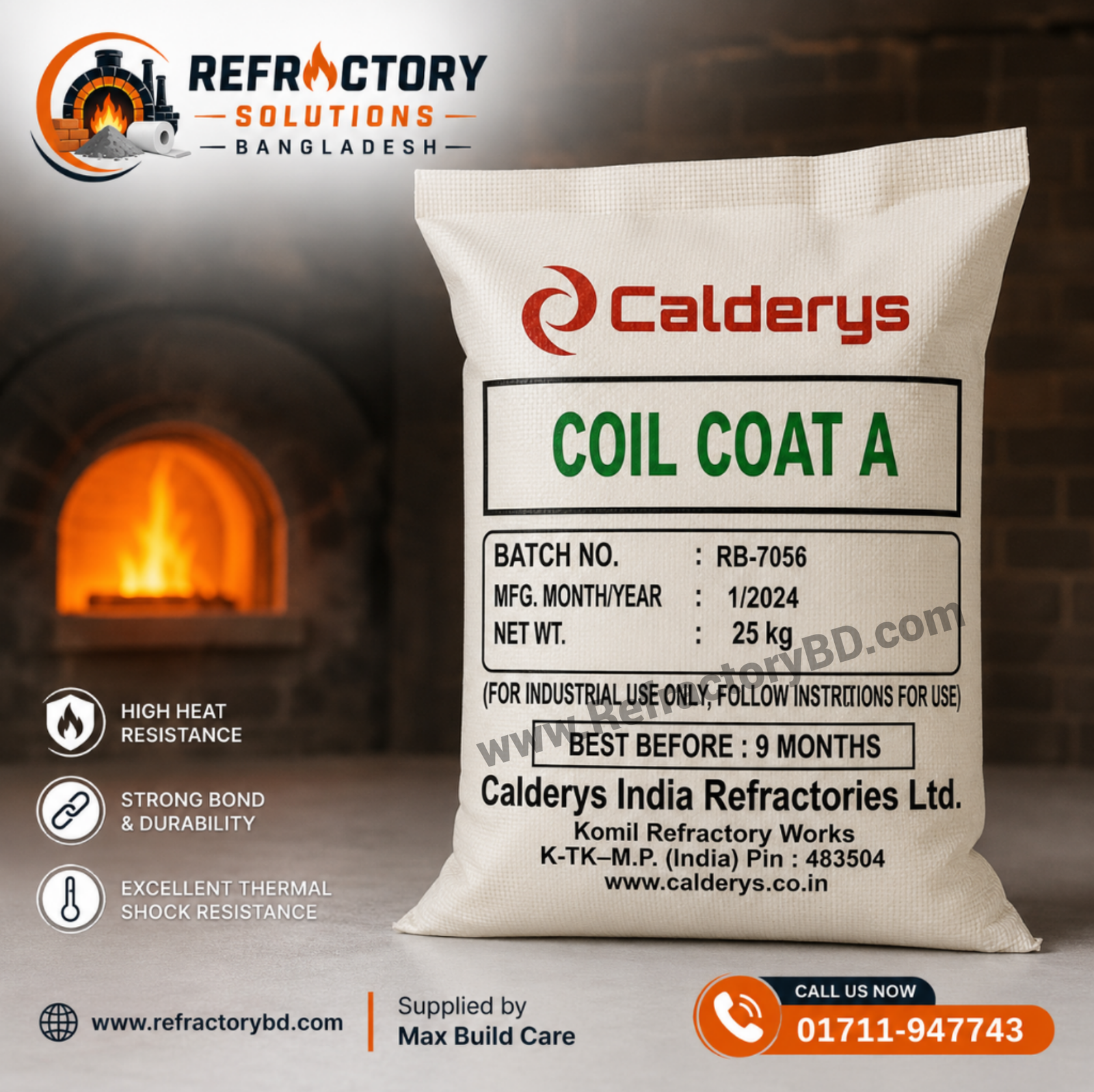
COIL COAT A is a specialized refractory coating designed to provide heat resistance and protective performance for industrial high-temperature applications. It helps protect refractory and metal surfaces from thermal exposure and supports durable furnace and kiln lining systems.
COIL COAT A is a specialized high-temperature refractory coating designed for use in demanding industrial environments where surfaces are exposed to elevated temperatures, thermal cycling, and harsh operating conditions. As part of a refractory coating system, it can be used to provide a protective layer over suitable refractory or heat-resistant surfaces and help improve the durability and service performance of industrial thermal equipment.
In high-temperature industrial equipment, refractory surfaces are continuously exposed to heat, thermal expansion and contraction, abrasion, gases, and other operating stresses. A suitable refractory coating can help protect the underlying surface and improve the overall integrity of the lining system.
COIL COAT A is intended for applications where a specialized heat-resistant coating is required. It can be considered for furnace, kiln, heating equipment, and other industrial thermal applications, subject to the manufacturer’s recommended application and service conditions.
Product Name: COIL COAT A
Product Type: Refractory Coating
Application: High-Temperature Surface Protection
Category: Refractory Coatings
One of the primary purposes of a refractory coating is to withstand exposure to elevated temperatures while maintaining adhesion and surface integrity. COIL COAT A is designed for high-temperature environments where conventional paints or ordinary protective coatings may not be suitable.
The coating creates a protective interface between the underlying surface and the surrounding thermal environment. When correctly selected and applied, this type of coating can contribute to improved resistance against heat-related surface deterioration and help maintain the performance of the refractory lining.
The actual maximum service temperature, chemical resistance, and other technical properties should always be confirmed from the manufacturer’s current Technical Data Sheet (TDS).
COIL COAT A can be used in suitable furnace and kiln-related applications where refractory surface protection is required. Industrial furnaces and kilns operate under severe thermal conditions, and their internal surfaces may experience repeated heating and cooling cycles.
A properly applied refractory coating can help seal and protect the surface of a refractory lining, depending on the specific formulation and application method. It may also be used during maintenance activities to restore or improve selected areas of an existing refractory system.
Before application, compatibility between the coating and the existing refractory material should be verified.
Refractory coatings are commonly used to provide an additional protective layer over refractory substrates. This can be particularly useful in areas where the surface requires improved resistance to thermal exposure or where a smoother, more uniform surface is desirable.
COIL COAT A should be applied only to surfaces that are suitable for the product. The substrate should generally be clean, stable, dry, and free from loose particles, dust, oil, grease, and other contaminants that could interfere with adhesion.
Proper surface preparation and application are essential for achieving satisfactory performance from any refractory coating. Depending on the manufacturer’s formulation, COIL COAT A may require specific mixing, dilution, application thickness, drying, curing, or heating procedures.
The coating should be applied evenly using the recommended application equipment and technique. Excessive thickness in a single application may cause drying or adhesion problems, so the manufacturer’s recommended coating thickness should be followed.
After application, adequate drying and controlled heating may be necessary before the equipment is returned to full operating temperature. The recommended dry-out schedule should be followed carefully to minimize the risk of cracking, blistering, or premature coating failure.
Depending on the confirmed product specification, COIL COAT A may be suitable for various high-temperature industrial environments, including:
The exact application range should be determined from the manufacturer’s product documentation.
COIL COAT A offers the potential benefits associated with specialized refractory coating systems, including:
The performance of a refractory coating depends heavily on its formulation, substrate compatibility, application thickness, drying procedure, and operating environment. Important technical parameters may include chemical composition, maximum service temperature, bulk density, adhesion strength, thermal expansion, coating thickness, drying time, and resistance to thermal cycling.
For this reason, specific numerical specifications should not be assumed solely from the product name. The manufacturer’s TDS, Safety Data Sheet (SDS), COA, and application guidelines should be consulted before commercial or industrial use.
COIL COAT A should be stored according to the manufacturer’s instructions in a suitable environment protected from excessive heat, moisture, contamination, and direct environmental exposure. Containers should remain properly closed when not in use.
During handling and application, appropriate personal protective equipment should be used according to the product’s SDS. Users should also ensure adequate ventilation and follow all manufacturer-recommended safety procedures.
COIL COAT A is a specialized refractory coating intended for high-temperature industrial environments where additional surface protection and refractory lining performance are required. Its application can support the protection of suitable refractory surfaces in furnaces, kilns, heating systems, and other thermal equipment.
For optimum results, correct product selection, substrate preparation, application thickness, drying, curing, and controlled heating are essential. The exact chemical composition, temperature rating, and recommended applications should be verified using the manufacturer’s latest TDS/COA before publishing detailed technical specifications on the website.
Website Category:
REFRACTORY PRODUCTS → REFRACTORY COATINGS → COIL COAT A